

Effective anti-climb fencing can be expensive. Before investing in a completely new high-security perimeter, it is worth considering whether you really need to replace the fence or whether an anti-climb system such as Roller Barrier could provide the protection you need at a much lower overall cost.
When a property needs better perimeter security, one of the first questions is usually: how much does anti-climb fencing cost in the UK?
The answer depends on the type and height of fencing, the site conditions, installation requirements and the level of security required. However, genuinely effective anti-climb fencing is rarely a cheap option.
High-security mesh fencing, palisade fencing and other specialist perimeter systems can cost £90–£150+ per metre installed, depending on the specification. For a large site, replacing an existing perimeter can therefore quickly become a substantial capital investment.
But there is another question worth asking:
Do you actually need to replace the fence?
In many situations, adding an effective anti-climb system to an existing fence can provide a much more economical way of improving perimeter security.
That is where Roller Barrier can offer an attractive alternative.

Fencetop Roller Barrier
What is anti-climb fencing?
Anti-climb fencing is designed to make it significantly more difficult for an unauthorised person to climb over a perimeter.
A conventional fence may establish a physical boundary, but a determined intruder may be able to climb over it using the mesh, rails, posts or other structural features as handholds and footholds.
High-security anti-climb fencing is designed to address this problem.
One of the best-known examples is 358 mesh fencing, sometimes called prison mesh, security mesh or anti-climb mesh. Its small apertures provide very few opportunities for someone to gain a secure handhold or foothold, while its heavy-gauge steel construction makes cutting considerably more difficult.
Other high-security perimeter options include:
-
358 welded mesh fencing
-
Steel palisade fencing
-
Vertical bar security fencing
-
High-security welded mesh systems
-
Fencing incorporating anti-climb toppings
-
Fencing combined with security gates, CCTV, alarms and other detection system.
The important point is that effective security fencing is different from ordinary boundary fencing. The stronger and more resistant to climbing, cutting and forced entry a fence needs to be, the more it is likely to cost.
How much does anti-climb fencing cost in the UK?
There is no single UK-wide price because every installation is different. As an indicative guide, recent published UK pricing places 358 anti-climb mesh fencing at around £90–£150 per metre for supply and installation, although actual costs can be higher or lower depending on the specification and site.
For comparison, indicative installed costs for other security fencing can include:
| Fencing Type |
Indicative Installed Cost Per Metre* |
| Standard chain-link fencing |
£25-£45 |
| Welded mesh fencing |
£50-£90 |
| Steel palisade fencing |
£70-£120 |
| 358 anti-climb mesh fencing |
£90-£150 |
| High-specification security fencing |
£150+ |
- * Indicative UK budgeting figures only. Actual prices depend on fence height, specification, ground conditions, access, foundations, gates, removal of existing fencing, installation and other site-specific requirements.
Published supplier prices also demonstrate how much the material specification can vary. For example, current 358 mesh systems are advertised at substantially different prices depending on height and configuration, before all installation costs are taken into account.
What does that mean for a 50-metre perimeter?
Consider a hypothetical 50-metre perimeter requiring 358 anti-climb mesh fencing.
50m × £90 = £4,500
50m × £150 = £7,500
And that is before considering possible additional costs such as:
-
Removing and disposing of existing fencing
-
Groundworks
-
Concrete foundations
-
Difficult access
-
Gates and access controls
-
Additional security features
-
Repairs to surrounding structures
-
Traffic management or specialist installation requirements.
For a 100-metre perimeter, the same indicative range becomes £9,000–£15,000.
For a large school, commercial site, industrial premises, public facility or other extensive perimeter, the cost can therefore become considerable.
Why is effective anti-climb fencing so expensive?
There are several reasons.
1. More steel means more cost
High-security fencing generally uses heavier materials and more robust posts, panels and fixings than conventional fencing.
358 mesh, for example, uses tightly spaced steel wires designed to make climbing and cutting more difficult. The material itself is therefore more substantial than ordinary mesh fencing.
2. Greater height increases the cost
A 3-metre security fence requires more material and substantially more robust supporting infrastructure than a 1.8-metre boundary.
Longer posts, deeper foundations, additional structural requirements and more difficult installation can all increase the final cost.
3. Installation is a major part of the budget
The price of the fence panels is only one part of the equation.
A complete security fencing project can involve:
-
Site preparation
-
Excavation
-
Concrete foundations
-
Posts and panels
-
Specialist fixings
-
Gates
-
Labour
-
Removal of existing fencing
-
Waste disposal
-
Access equipment.
This is why comparing the price of a fencing panel with the price of a completed installation can be misleading.
4. Existing fencing may already be perfectly adequate
Perhaps the most important consideration is that the existing fence may not actually be the problem.
If the fence is structurally sound and provides an appropriate perimeter boundary, replacing the entire installation simply because it is relatively easy to climb may not be the most cost-effective solution.
Instead, it may be possible to upgrade its anti-climb performance.
Could you upgrade your existing fence instead?
In many circumstances the answer to this question is - yes. The existing fencing can potentially be upgraded.
Rather than removing an existing fence and installing an entirely new high-security perimeter, an alternative approach is to install an anti-climb topping system.
This can be particularly attractive where:
-
The existing fence is structurally sound
-
The fence provides adequate boundary security
-
The principal weakness is climbing
-
The site has a large perimeter
-
Budget is limited
-
Disruption needs to be minimised
-
The appearance of the existing boundary needs to be retained.
This approach can turn a potentially expensive fencing replacement project into a much more targeted security upgrade.
Roller Barrier: an alternative to expensive anti-climb fencing
Roller Barrier is a non-aggressive anti-climb system designed to prevent unauthorised climbing over fences, walls, gates and other structures.
Instead of replacing the entire fence, Roller Barrier can be installed above an existing perimeter.
Its independently rotating cups are designed to be too large to grip comfortably. When someone attempts to climb over the protected structure, the rotating rollers create an unstable surface that makes climbing extremely difficult.
This makes Roller Barrier particularly useful where the objective is to improve the anti-climb performance of an existing fence without undertaking a complete fencing replacement.
The potential cost advantage
Imagine a site with 100 metres of existing fencing. Replacing the entire perimeter with a high-security anti-climb fencing system could potentially cost many thousands of pounds once materials, posts, foundations and installation are included.
But if the existing fence is sound, there may be no reason to replace all 100 metres.
Instead, the anti-climb weakness can potentially be addressed by installing Roller Barrier along the top.
This is the fundamental economic advantage of a retrofit anti-climb solution:
You can improve the security of an existing perimeter without necessarily paying to replace the entire perimeter.
Roller Barrier is designed for relatively straightforward installation and can be fitted to many types of walls, fences, gates and building structures. Standard brackets are available for different applications, while bespoke brackets can also be produced where required.
Roller Barrier can also provide additional height
There are situations where simply adding a single row of anti-climb rollers may not provide sufficient protection.
For these applications, Roller Barrier is available in different configurations.
Single Roller Barrier
The single-row system provides a straightforward anti-climb solution for many conventional fences, walls and gates.
Double Roller Barrier
A double-row installation provides additional height and can be particularly useful where a higher level of protection is required.
It can also be installed using cranked brackets to alter the angle and increase the effective width of the barrier.
Trigard Roller System
For lower-level applications, the Trigard system uses three rows of Roller Barrier to create a wide, unstable anti-climb barrier.
This can be particularly useful in environments such as schools, public spaces and other locations where aggressive anti-climb products would be inappropriate.
Is Roller Barrier cheaper than anti-climb fencing?
It can be, particularly where an existing fence is structurally sound and only requires anti-climb enhancement.
However, it is important not to make a direct price-per-metre comparison between Roller Barrier and a completely new fence because they solve slightly different problems.
A new high-security fence provides the entire perimeter structure.
Roller Barrier is primarily an anti-climb upgrade that can be installed onto an existing structure.
The financial comparison should therefore be:
Cost of replacing an existing perimeter
versus
Cost of retaining the existing perimeter and upgrading its anti-climb performance.
For many sites, the second option can be considerably more economical.
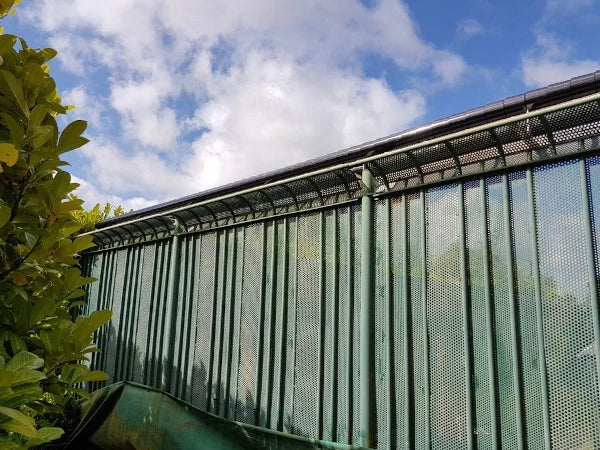
Security Fence Topped with Roller Barrier
What else affects the cost of anti-climb security?
The headline price per metre isn't the only consideration when planning a perimeter security project.
Fence condition
If the existing fence is damaged, unstable or structurally inadequate, upgrading it with an anti-climb system may not be appropriate until the underlying problems have been addressed.
Fence height
A relatively low fence may be straightforward to climb even when topped with an anti-climb system. The appropriate Roller Barrier configuration can therefore depend on the height and design of the existing perimeter.
Gates
Gates can create an important vulnerability in an otherwise secure perimeter. Anti-climb protection can be extended across suitable gates to help maintain continuity of the security boundary.
Changes in level
Sloping ground, steps and changes in fence height can affect the design of an anti-climb installation. Roller Barrier runs can be configured to accommodate different sections and changes in direction.
Site environment
Schools, hospitals, public parks and other environments may require a non-aggressive anti-climb solution because people could come into contact with the security system.
This is one reason Roller Barrier is used in environments including schools, healthcare settings, public spaces and other locations where spiked or aggressive products may be unsuitable.
Anti-climb fencing isn't always the cheapest security solution
It is tempting to focus on the price of fencing panels when comparing security options.
But the real question should be:
What is the most cost-effective way of achieving the required level of security?
If an existing fence is fundamentally sound, replacing it may involve paying for:
-
New fence panels
-
New posts
-
Foundations
-
Labour
-
Removal of the old fence
-
Waste disposal
-
Potentially new gates
-
Site disruption.
An anti-climb retrofit can potentially eliminate many of those costs.
This is why it makes sense to consider layered perimeter security rather than automatically assuming that a completely new fence is required.
A smarter approach to perimeter security
For commercial premises, schools, public buildings, industrial sites and other vulnerable locations, an effective security strategy may combine several measures.
For example:
Existing fence + Roller Barrier + security lighting + CCTV + controlled access
can create a significantly more comprehensive security arrangement than relying on a fence alone.
The objective is not simply to construct the biggest or strongest fence possible.
It is to create a perimeter that discourages unauthorised access, delays attempted intrusion and makes the site more difficult to penetrate.
Is anti-climb fencing worth the investment?
For high-risk sites, a properly specified security fence can be an excellent investment.
However, the cost of effective anti-climb fencing means that it is worth considering all available options before committing to a complete perimeter replacement.
If your existing fence is structurally sound, retrofitting an anti-climb system could be a more economical approach.
Roller Barrier provides a practical alternative by adding a rotating anti-climb barrier to the top of existing fences, walls and gates. It is designed to be effective without relying on dangerous spikes or other aggressive deterrents.
Frequently Asked Questions
How much does anti-climb fencing cost per metre in the UK?
As an indicative guide, 358 anti-climb mesh fencing can cost around £90–£150 per metre installed, although the actual price will depend on height, specification, ground conditions, access and installation requirements. High-security installations can cost more.
What is the cheapest effective anti-climb solution?
Where an existing fence is structurally sound, retrofitting an anti-climb topping can potentially be much more economical than replacing the entire fence. The most appropriate solution depends on the site and the level of security required.
Can anti-climb fencing be added to an existing fence?
Yes. A number of anti-climb systems are designed to retrofit onto existing fences and walls. Roller Barrier, for example, is specifically designed to provide anti-climb protection on existing fences, walls, gates and other structures.
Is 358 mesh the best anti-climb fence?
358 mesh is a highly effective high-security fencing option, particularly where resistance to climbing and cutting is important. However, it is not necessarily the most cost-effective solution for every site. If the existing perimeter is sound, an anti-climb retrofit may provide the required protection without replacing the whole fence.
Is Roller Barrier an alternative to anti-climb fencing?
Yes, in many applications. Roller Barrier is an anti-climb system rather than a replacement fence. It can be installed on suitable existing fences, walls and gates to make climbing significantly more difficult.
Is Roller Barrier safe around children?
Roller Barrier is a non-aggressive anti-climb system and does not use spikes or blades. This makes it particularly suitable for locations such as schools and other environments where children or vulnerable people may be present.
Always Assess the Cost of Upgrading
Effective anti-climb fencing can provide excellent security, but it can also represent a substantial investment, particularly when a large perimeter needs to be replaced.
Before committing to a complete fencing project, ask whether the existing fence really needs to go.
If the fence is sound but easy to climb, upgrading it may be a much more economical solution.
Roller Barrier provides a versatile, non-aggressive way to enhance the anti-climb performance of existing fences, walls and gates — potentially delivering the security improvement you need without the cost and disruption of installing an entirely new perimeter.
Find out whether Roller Barrier could be suitable for your site. Contact the Roller Barrier team for advice on the most appropriate configuration for your fence, wall, gate or other structure.